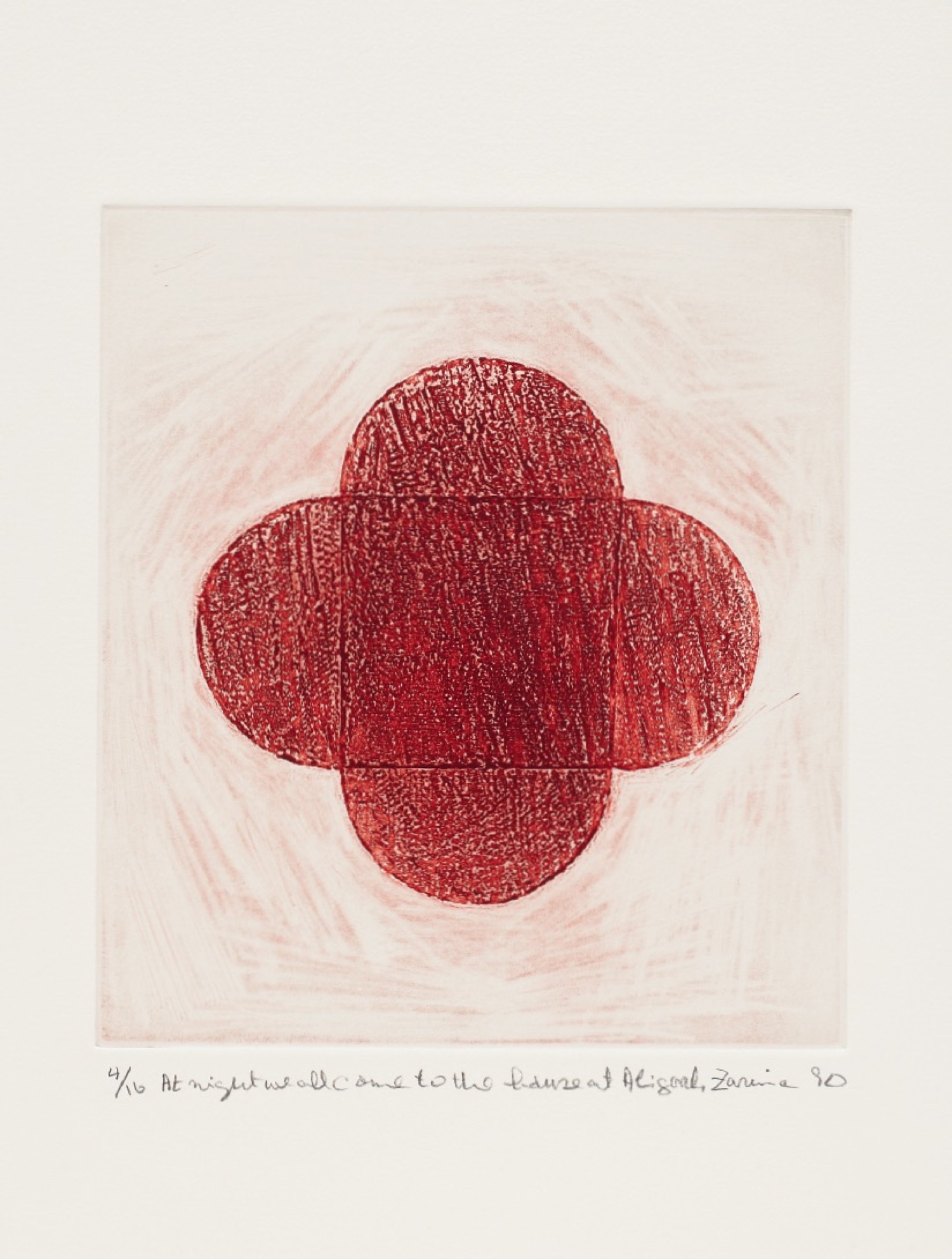
Aligarh remained the origin point of Zarina’s visual and emotional geography: a university town, a family house, and a world measured through rooms, thresholds, and remembered routes.
At Night We All Come to the House at Aligarh, 1990
The first house
A whole world within four walls
Zarina was born and raised in Aligarh, a university town about one hundred miles from Delhi. Her father taught history at Aligarh Muslim University, and the intellectual and cultural life around the university shaped the household in which she grew up.
The courtyard, her mother’s garden, the fragrance of flowers, family gatherings, and the plan of the house became recurring structures in her work. Many later works carry Aligarh in their titles because the city was not simply a birthplace; it was the measure against which every subsequent home was understood.
Books and printed words
Prints as part of the book
In the house at Aligarh I grew up surrounded by books. My father was professor of history at the AMU, we had a large collection of books at home. Even before I learned to read I loved to look at the printed words and images. This is what drew me to printmaking and the book.
One is influenced by so many things, words, images, sounds and smells. For me prints are part of the book, I see no need for prints to compete with painting on canvas. These are two different means of expression, two different sensibilities.
Zarina · legacy family site
Partition and return
A line through home
Zarina was ten when British India was divided in 1947. Partition marked her understanding of borders as forces that could divide land, language, families, and memory. Its emotional consequences remained present across works about maps, journeys, and displacement.
On a later visit, an old friend of her mother described the strangeness of apartment life, where neither the floor nor the roof belonged to the occupant. Zarina connected that remark to a wall of numbered funerary boxes she had seen in Southeast Asia: another gridded architecture in which dwelling had been separated from belonging.
“Families were split, homes destroyed, the fabric of life for millions of people was permanently altered—all for this new border, this Dividing Line.”